



Introduction
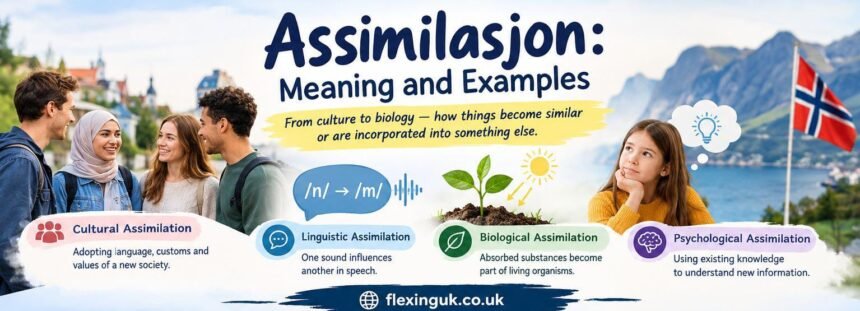
The word assimilasjon is a Norwegian term that translates to assimilation in English. It describes a process in which something becomes similar to, or is incorporated into, something that already exists. The exact meaning depends on the context in which the word is used. It can refer to cultural change, language pronunciation, biological processes, or the way people understand new information.
For someone searching for assimilasjon, the most important question is what the word means and how it is used in everyday life and academic subjects. In social studies, it often describes how individuals or minority groups adopt the language, customs, and values of a larger society. In linguistics, it refers to changes in speech sounds. In biology, it describes how organisms absorb and transform substances into materials they can use.
Understanding these different meanings makes the term easier to recognize in books, school assignments, discussions, and educational resources. This guide explains assimilasjon in simple English, provides practical examples, and explores how it differs from related concepts such as integration and adaptation.
What Does Assimilasjon Mean?
Assimilasjon means assimilation: the process of becoming similar to something else or incorporating something into an existing system. The term comes from a Latin word associated with making something similar.
Although the basic idea remains similar across different subjects, its practical meaning changes depending on the situation. A person may adapt to the culture of a new country, a sound may change because of a neighboring sound, or an organism may transform absorbed nutrients into parts of its body.
The Norwegian dictionary defines assimilasjon in several fields, including social studies, linguistics, biology, psychology, and geology. Therefore, readers should consider the surrounding sentence before deciding which meaning applies.
Assimilasjon in Simple English
In simple English, assimilasjon means becoming more like something else or making something part of an existing whole.
Consider these examples:
- Culture: A person learns the language and customs of the country where they live.
- Language: A speech sound changes to become more similar to another sound.
- Biology: An organism converts absorbed substances into materials needed for growth.
- Psychology: A person interprets a new experience using knowledge they already have.
Each example involves a relationship between something new and something already established. However, these processes are not identical, and each field uses the term according to its own principles.
What Is the Origin of the Word Assimilasjon?
Assimilasjon has its roots in Latin and is related to the idea of making something similar. The English word assimilation developed from the same linguistic background.
In Norwegian, assimilasjon is a noun. The related verb is assimilere, which means to assimilate or incorporate something into an existing whole. The related noun assimilering also appears in Norwegian usage.
These related words can help readers understand Norwegian texts, especially when the term appears in academic writing or discussions about society, language, and science.
Assimilasjon in Society and Culture
One of the most common uses of assimilasjon is in sociology and discussions about cultural identity. In this context, assimilation describes a process through which people or groups adopt cultural characteristics associated with another group, often the majority population.
These characteristics may include language, everyday customs, social expectations, and patterns of behavior. The process can happen gradually through education, work, friendships, family life, or wider social influences. In other situations, governments or institutions have actively encouraged or forced minority communities to abandon parts of their cultural heritage.
Cultural assimilation is therefore more complex than simply learning how to live in a new country. It can involve questions about identity, belonging, language, personal choice, and the ability to preserve cultural traditions.
Examples of Cultural Assimilation
Imagine a family moving to a country where the main language differs from the language they speak at home. Over time, family members learn the local language, become familiar with national customs, and participate in community activities.
These changes may be examples of cultural adaptation. Whether they represent assimilation depends on how far the individuals adopt the dominant culture and whether they maintain their original cultural practices.
Other examples include:
- A person gradually replacing their first language with the dominant language in most everyday situations.
- A community adopting the majority population’s social customs over several generations.
- A person changing their name or manner of dress because they feel pressure to fit into the surrounding society.
- A child becoming more familiar with the traditions of the country where they attend school while also learning family traditions at home.
These situations are not necessarily equal in meaning or consequence. Learning a language can be a personal choice that creates opportunities, while abandoning a heritage language because of discrimination or institutional pressure can involve a loss of cultural freedom.
Assimilation and Cultural Identity
Cultural identity refers to the traditions, experiences, languages, beliefs, and relationships that help people understand their connection to a community. Assimilation may influence this identity when individuals increasingly adopt the customs of another cultural group.
Some people willingly embrace new cultural practices while maintaining a strong connection to their heritage. Others may feel pressure to hide their background to avoid prejudice or gain acceptance.
It is important not to assume that everyone experiences assimilation in the same way. A person’s experience depends on family circumstances, social relationships, public policies, and the opportunities available to them.
A balanced understanding recognizes that people can participate in a wider society without necessarily abandoning every part of their original identity.
Assimilasjon vs. Integration: What Is the Difference?
Assimilasjon and integration are related concepts, but they do not mean exactly the same thing. Both concern how individuals and groups become part of a wider society. The main difference is the role that cultural differences play in the process.
Assimilation traditionally emphasizes becoming more similar to the dominant culture. Integration emphasizes participation in society while allowing people to retain aspects of their distinct cultural identities.
| Feature | Assimilasjon (Assimilation) | Integration |
|---|---|---|
| Main emphasis | Becoming more similar to the dominant culture | Participating in society |
| Cultural identity | May involve reducing differences from the majority | Can allow cultural differences to remain |
| Language | May involve adopting the dominant language in place of a heritage language | Encourages communication while allowing multilingualism |
| Social participation | Often associated with adopting dominant social norms | Focuses on access, participation, and inclusion |
| Example | A person gradually stops using their heritage language and adopts the majority culture’s practices | A person learns the local language while continuing to speak their heritage language |
These descriptions explain common distinctions rather than every possible real-world situation. The terms can be used differently across academic disciplines and political discussions.
Also Read: Magfusehub Com: A Guide to Understanding the Website
Can Assimilation and Integration Happen Together?
Yes. A person may experience both processes at the same time.
For example, someone who moves to Norway may learn Norwegian, understand local workplace expectations, and build friendships with people from different backgrounds. These experiences can support integration and may also involve adopting certain cultural practices.
However, the person may continue speaking another language at home, celebrating family traditions, and maintaining connections with their original community.
The important point is that participation in society does not automatically require complete cultural assimilation. The two concepts overlap in some situations but describe different emphases.
Assimilasjon in Linguistics
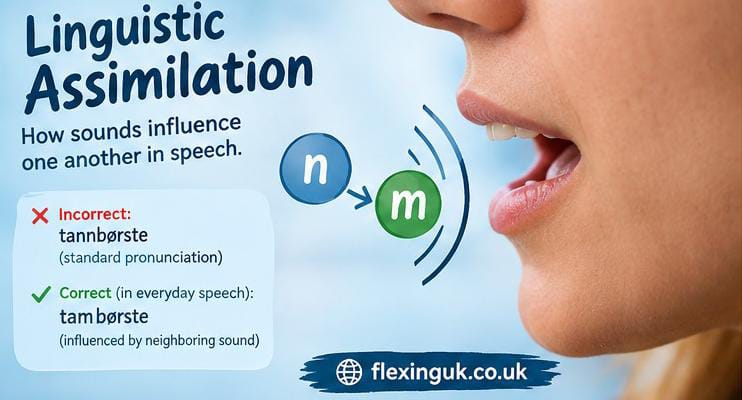
In linguistics, assimilasjon refers to a process in which one speech sound becomes partly or completely similar to another sound. This happens because the movements of the tongue, lips, and other speech organs overlap during natural speech.
Speakers do not produce every sound as an entirely separate action. Instead, speech sounds influence one another as people move quickly from one word or sound to the next. Assimilation can make pronunciation easier and can occur even when the spelling of a word remains unchanged.
Linguists study this process to understand pronunciation, sound patterns, language development, and historical changes in words.
Contact Assimilation
Contact assimilation occurs when sounds that are close together influence each other.
For example, the Norwegian word tannbørste may be pronounced in everyday speech with the nasal sound becoming more like the following lip-produced consonant. A pronunciation resembling tambørste illustrates how a sound can change under the influence of a neighboring sound.
This does not mean that the spelling must change. The example describes a possible pronunciation pattern, not a recommendation to replace the standard spelling.
Distant Assimilation
Distant assimilation occurs when a sound is influenced by another sound that is not immediately next to it.
A familiar linguistic example is vowel harmony. In languages such as Turkish, the form of a suffix can depend on the vowel in the word stem. This allows sounds in different parts of a word to follow a related pattern.
For learners, the main distinction is straightforward:
- Contact assimilation: Nearby sounds influence one another.
- Distant assimilation: Sounds separated within a word influence one another.
These processes show that pronunciation follows patterns rather than consisting of completely independent sounds.
Assimilasjon in Biology
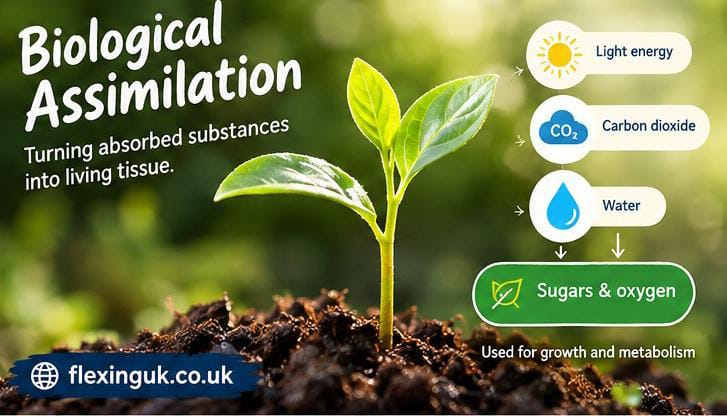
In biology, assimilation describes the process through which absorbed substances are converted into materials that an organism can use as part of its cells and tissues.
For example, plants absorb substances from their surroundings and use them in processes that support growth. During photosynthesis, plants use light energy to convert carbon dioxide and water into sugars, releasing oxygen. The resulting organic compounds can contribute to the plant’s growth and metabolism.
Assimilation is also relevant to how animals use nutrients obtained from food. Digestion breaks food into smaller substances, absorption transfers those substances into the body, and metabolism uses or transforms them. Assimilation refers more specifically to incorporating absorbed materials into the organism’s own structures or compounds.
Examples of Biological Assimilation
Consider a growing plant. It uses products of photosynthesis to build new tissues and support its development. The process connects materials from the environment with the plant’s biological needs.
Other examples include:
- A plant incorporating nitrogen obtained from the soil into amino acids and proteins.
- An organism using absorbed nutrients to build cellular materials.
- Biological systems converting simple substances into compounds needed for growth and maintenance.
The details vary by organism and substance, but the central idea remains the same: materials become part of the organism through biological processes.
Read more: Glaadvoice.com: What It Is, What It Covers, and How to Evaluate the Website
Assimilasjon in Psychology and Learning
Assimilasjon also has a specific meaning in psychology, particularly in theories of cognitive development. It describes how people interpret new experiences using knowledge or mental structures they already possess.
People do not approach every new experience without prior understanding. Instead, they often compare new information with what they already know and use familiar concepts to make sense of it.
For example, a young child who knows what a dog looks like may see a wolf and initially call it a dog. The child is applying an existing category to something unfamiliar. This illustrates assimilation in learning, although further experience may later lead the child to refine their understanding.
Assimilation and Accommodation
In developmental psychology, assimilation is often discussed alongside accommodation.
Assimilation occurs when new information fits into an existing mental framework. Accommodation occurs when a person changes an existing framework or develops a new one to explain information that does not fit.
| Concept | Meaning | Example |
|---|---|---|
| Assimilation | Using an existing understanding to interpret new information | A child calls an unfamiliar breed of dog a dog |
| Accommodation | Changing an existing understanding to account for new information | A child learns that a wolf is a different animal from a domestic dog |
Both processes can contribute to learning. People may initially interpret unfamiliar situations using familiar ideas, then adjust those ideas when they discover important differences.
This distinction can be useful for students studying psychology, education, or child development.
Other Scientific Uses of Assimilasjon
Although social studies, linguistics, biology, and psychology are common contexts, the term also appears in other scientific fields.
In geology, assimilation can describe surrounding rock material becoming incorporated into magma. The details depend on geological conditions and the interaction between molten material and surrounding rock.
In botany, assimilation may refer to the uptake and transformation of inorganic substances into organic compounds. In physiology, it can describe the incorporation of digested and absorbed nutrients into cells and tissues.
These specialized meanings share a broad theme: something is incorporated into an existing system or transformed into a form that becomes part of it.
When reading a scientific text, it is helpful to identify the subject first. A discussion about rocks, cells, speech sounds, or cultural identity will require a different explanation of the same word.
Assimilation in Norwegian History
The word assimilasjon can carry particular historical significance in Norway, especially in discussions about the Sámi people and other minority communities.
Norwegianization policies sought to make Sámi and Kven communities more similar to the Norwegian-speaking majority. These policies included pressure to use Norwegian and to move away from aspects of minority languages and cultural traditions. Their effects are important to discussions about language rights, education, identity, and historical injustice.
This history demonstrates why assimilation should not always be understood as a neutral process of learning new customs. When authorities pressure people to abandon their language or heritage, assimilation can involve coercion and long-lasting cultural harm.
It is equally important to distinguish between historical state policies and the individual choices people make when learning a language or participating in a new community. The same broad term can describe processes with very different circumstances and consequences.
Understanding the historical context helps readers interpret the word accurately in Norwegian news, school materials, and social discussions.
Common Misunderstandings About Assimilasjon
Because assimilasjon has several meanings, readers sometimes misunderstand how it should be used. The following points help prevent common errors.
Mistake 1: Assuming Assimilation Always Means Immigration
Assimilation is not limited to people moving between countries. The term also appears in language science, biology, psychology, geology, and other fields.
Better understanding: Identify the context before interpreting the word.
Mistake 2: Treating Assimilation and Integration as Identical
The terms overlap, but they are not interchangeable in every situation. Assimilation usually places greater emphasis on becoming similar to a dominant group, while integration focuses on participation in a wider society.
Better understanding: Explain the specific process instead of using the terms as automatic synonyms.
Mistake 3: Assuming Assimilation Is Always Voluntary
Some people adopt new practices by choice. Others face pressure from institutions, communities, or discriminatory social expectations.
Better understanding: Consider whether the process involves personal choice, social influence, or coercion.
Mistake 4: Assuming Linguistic Assimilation Changes Spelling
A sound may change during everyday speech without any change to the written form of the word.
Better understanding: Distinguish between pronunciation and standard spelling.
Mistake 5: Using One Definition for Every Scientific Subject
The meaning of assimilation in biology differs from its meaning in sociology or psychology.
Better understanding: Use the surrounding sentence, subject area, and examples to determine the intended meaning.
How to Understand Assimilasjon in a Sentence
A practical way to understand the term is to examine the words around it. The subject of the sentence often reveals which definition applies.
Consider these original examples:
- Social studies: “The researcher examined how cultural assimilasjon affected the community’s heritage language.” Here, the term refers to cultural change.
- Linguistics: “Assimilasjon can change the way neighboring consonants are pronounced.” Here, it refers to a sound pattern.
- Biology: “The lesson explained assimilasjon as the incorporation of nutrients into living tissues.” Here, it describes a biological process.
- Psychology: “The student used assimilasjon to interpret a new experience through existing knowledge.” Here, it refers to learning and cognition.
- Geology: “The geologist studied the assimilation of surrounding rock into magma.” Here, the term describes a geological process.
When studying or translating Norwegian texts, ask three questions:
- What subject is being discussed?
- What is being changed, absorbed, or made similar?
- Does the example involve people, sounds, living organisms, knowledge, or physical materials?
Answering these questions will usually help you identify the intended meaning without relying on a single general definition.
Frequently Asked Questions About Assimilasjon
1. What does assimilasjon mean in English?
Assimilasjon is the Norwegian word for assimilation. It generally describes the process of becoming similar to something else or incorporating something into an existing whole. Its precise meaning depends on the context.
2. What is the main meaning of assimilasjon in society?
In social studies, assimilasjon describes how individuals or groups adopt cultural characteristics associated with another group, often the majority population. These characteristics may include language, customs, social expectations, and values.
3. What is the difference between assimilasjon and integration?
Assimilasjon generally emphasizes becoming more similar to the dominant culture. Integration emphasizes participation in society and can allow people to maintain distinct cultural identities. The concepts may overlap in real-life situations.
4. What does assimilasjon mean in linguistics?
In linguistics, assimilasjon occurs when one speech sound becomes partly or completely similar to another sound. It commonly happens because neighboring sounds influence the movements used to produce speech.
5. What is assimilasjon in biology?
In biology, assimilation refers to incorporating absorbed substances into an organism’s cells, tissues, or other biological compounds. For example, plants use substances from their environment to produce materials needed for growth.
6. What is the difference between assimilation and accommodation in psychology?
Assimilation involves interpreting new information through an existing mental framework. Accommodation involves changing that framework when the information does not fit. Both processes help explain how people learn.
7. Can assimilation happen without force?
Yes. People may voluntarily adopt new languages, habits, or cultural practices through relationships, education, employment, and everyday experiences. However, assimilation can also be encouraged through social pressure or imposed through government policies.
8. Why is assimilasjon important to understand?
The term helps readers understand discussions about cultural identity, language development, biological processes, and learning. Recognizing its different meanings prevents confusion and makes academic and everyday texts easier to interpret.
Conclusion
Assimilasjon is a versatile Norwegian term whose English equivalent is assimilation. Its central idea involves becoming similar to something else or incorporating something into an existing system, but the exact meaning changes across different subjects.
In society, it can describe the adoption of dominant cultural practices. In linguistics, it explains how speech sounds influence one another. In biology, it concerns the incorporation of substances into living organisms, while in psychology, it describes how people interpret new information through existing knowledge.
For more: Visit: FlexingUK