




Introduction
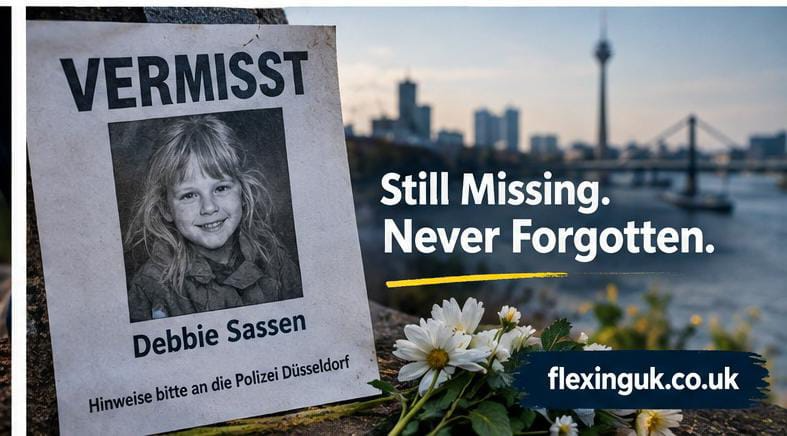
The name Debbie Sassen remains associated with one of Düsseldorf’s most enduring missing-person cases. In February 1996, eight-year-old Deborah “Debbie” Sassen disappeared while making her way home from school in the Düsseldorf district of Wersten. Her home was less than a kilometre from the school, yet she never arrived.
For decades, investigators, relatives, and members of the public have been left with the same unanswered question: what happened to Debbie Sassen?
The case has never simply disappeared into history. In 2026, almost three decades after Debbie vanished, German investigators carried out new searches, identified a concrete suspect, and secured possible evidence. Further searches were conducted in March 2026, showing that authorities continue to investigate the case.
This article looks at what is publicly known about Debbie Sassen, the circumstances surrounding her disappearance, the investigation over the years, and why the case continues to attract attention.
Who Was Debbie Sassen?
Deborah Sassen, commonly known as Debbie, was an eight-year-old girl living in Düsseldorf-Wersten in 1996.
She attended a primary school on Rheindorfer Weg. On February 13, 1996, she was at school during the morning and later began making her way home. According to reports, she realized that she had forgotten something and returned to the school before leaving again through a rear entrance.
Her disappearance was particularly disturbing because the distance between her school and her family home was very short. She was last seen at around noon, and the journey should not have taken long.
What Did Debbie Look Like?
Contemporary descriptions identified Debbie as a blonde girl who was approximately 1.20 metres tall. On the day she disappeared, she was wearing a distinctive red jacket and red clothing, details that became important during the initial search.
The combination of her age, clothing, and the short route home made the disappearance an urgent priority for investigators.
What Happened to Debbie Sassen?
The exact circumstances remain unresolved.
Debbie was last seen around midday on February 13, 1996, after leaving her school. She was expected to return home, but she disappeared before reaching her family.
Investigators have long treated the disappearance as a criminal case rather than simply an unexplained absence. German authorities have stated that they believe Debbie was murdered, although her body has never been recovered and no perpetrator has been convicted in connection with her disappearance.
That distinction is important. A police theory or investigative assumption is not the same as a court-established fact.
Why Was the Case So Difficult to Solve?
One of the central difficulties is the absence of Debbie’s body.
Without a recovered body, investigators have had to work with witness accounts, physical evidence, possible locations, and other investigative leads. Evidence that might have seemed insignificant in 1996 can potentially become more useful decades later as forensic techniques develop.
The case also illustrates one of the fundamental challenges of a cold case: memories fade, people move, locations change, and physical evidence can become harder to interpret.
The Original Search for Debbie
The disappearance triggered a major search operation in Düsseldorf.
Police officers and volunteers searched surrounding areas, properties, and possible routes. Investigators also followed witness information and considered different possibilities concerning what might have happened to the child.
Reports from the period describe an extensive search effort, including examinations of properties in the area. Yet despite the scale of the operation, Debbie was not found.
Her photograph and information about the disappearance also circulated publicly, including through a campaign involving the Tuffi milk brand, which helped spread awareness of the missing child.

The Case Becomes a Cold Case
As years passed without a breakthrough, the disappearance became what is commonly called a cold case.
A cold case does not necessarily mean that police have abandoned an investigation. In Debbie Sassen’s case, authorities have repeatedly emphasized that the investigation remained open.
That matters because advances in forensic science can sometimes give investigators opportunities that did not exist when a crime originally occurred.
What Makes a Cold Case Different?
A cold case may involve:
- Evidence that was inconclusive at the time
- Witnesses who remember new details years later
- Improved DNA analysis
- Newly discovered documents or objects
- Changes in investigative technology
- New information about people connected to the case
These developments can sometimes reopen investigative paths that appeared exhausted.
New Developments in the Debbie Sassen Case
One of the biggest developments came in January 2026, when police and prosecutors announced new investigative measures nearly 30 years after Debbie disappeared.
Several houses and apartments in Düsseldorf were searched on January 26 and 27. The Düsseldorf homicide investigation team received support from the German Federal Criminal Police Office, known as the BKA. Possible evidence was secured during the searches.
Authorities also carried out work involving a cesspit in Wersten. The area was emptied and the ground was examined, but Debbie’s body was not found there.
Was There a Suspect?
Yes. In January 2026, prosecutors confirmed that investigators had a concrete suspect.
However, the suspect had not been placed in pre-trial detention at the time of the public announcements. Authorities also clarified that the person under investigation was not from Debbie’s family environment.
This is a crucial point when discussing the case. Having a suspect does not mean that the person’s guilt has been established. The investigation must still determine whether the available evidence can connect that individual to Debbie’s disappearance.
Why Did Investigators Search Again?
The renewed investigation followed new investigative leads.
Police said that the case file had never been closed and that the new measures were based on further investigative approaches. Possible evidence recovered during the searches was to be examined, including for potential forensic material.
For investigators, the passage of time does not necessarily eliminate every opportunity. Modern forensic methods can sometimes provide information from material that could not be adequately examined decades earlier.
At the same time, authorities have not publicly disclosed every detail of the investigation, which is understandable while a criminal inquiry remains active.
Further Searches in March 2026
The investigation did not end with the January searches.
In March 2026, police returned to a property in Wersten for additional searches. Investigators broke through the concrete floor of a garden shed and continued examining the property. They encountered a layer of water while digging, but the searches did not immediately produce Debbie’s remains.
The renewed activity demonstrated that investigators were still pursuing specific leads rather than treating the case as closed history.
The Importance of Physical Evidence
Physical evidence can become particularly important in a decades-old investigation.
Objects, soil, structures, containers, clothing, and other materials may potentially preserve information. Modern laboratory techniques can also change the value of evidence that was previously difficult to interpret.
However, it is important not to assume that every item recovered during a search is necessarily connected to a crime. Investigators must establish relevance through forensic analysis and other evidence.
The Role of Witnesses
Witness information has been important throughout the Debbie Sassen investigation.
Over the years, authorities have received reports concerning people, vehicles, and circumstances around the time of the disappearance. One reported line of investigation involved a man and a beige-coloured car seen in the area.
Witness recollections can be valuable, but they also need to be assessed carefully.
Human memory is not a perfect recording device. After many years, memories can become incomplete or change as people encounter new information. Investigators therefore have to compare testimony with other evidence.
Debbie Sassen and the Search for Closure
For Debbie’s family, the case is not simply an old police investigation.
More than 30 years after her disappearance, her mother has continued to live with uncertainty. In a 2026 WDR report connected to the International Day of Missing Children, Debbie’s mother, Dagmar Funke, spoke about still remembering her daughter as a happy young girl.
That perspective highlights something often lost when cold cases are discussed only through timelines and evidence.
For a family, an unresolved disappearance can remain present for decades.
Why Closure Matters
Closure does not necessarily mean that every question will receive an immediate answer.
For families of missing people, it can mean discovering what happened, understanding the circumstances, recovering remains, or seeing a criminal investigation reach a legally established conclusion.
In Debbie Sassen’s case, the renewed investigation has provided a reason for cautious hope, but it has not yet provided a final resolution.
Debbie Sassen and the Broader Problem of Missing Children
The case also belongs to a much wider discussion about missing children.
When a child disappears, the first hours and days can be crucial. Police, families, witnesses, volunteers, and members of the public may all play important roles in searching for information.
Cold cases like Debbie’s also demonstrate why information can remain valuable long after the original investigation.
A person who remembers something decades later may believe it is too late to matter. In some cases, however, even a small detail can help investigators connect separate pieces of evidence.
What Is Known and What Remains Unknown?
It is useful to separate established information from unanswered questions.
| Known information | Still unresolved |
|---|---|
| Debbie was eight years old in 1996. | What exactly happened after she left school? |
| She disappeared in Düsseldorf-Wersten. | Where is Debbie today? |
| She was last seen around midday. | Who is responsible? |
| Her home was less than 1 km from the school. | Where are any remains? |
| Police believe she was the victim of a crime. | Can the current evidence lead to a conviction? |
| A concrete suspect was identified in 2026. | What evidence ultimately links the suspect to the case? |
| New searches were conducted in 2026. | Whether the investigation will reach a final resolution. |
This distinction is essential for responsible reporting. A compelling theory is not automatically a proven fact.
Common Mistakes When Searching for Information About Debbie Sassen
The name Debbie Sassen can also refer to other people, which creates a potential search problem.
Mistake 1: Assuming Every Debbie Sassen Search Refers to the Same Person
The exact name appears in multiple contexts. For example, there is also a financial professional and entrepreneur named Debbie Sassen with her own public website and business activities.
When researching the Düsseldorf case, terms such as Deborah Sassen Düsseldorf, Debbie Sassen missing, or Debbie Sassen 1996 can make the search intent much clearer.
Mistake 2: Treating a Suspect as a Convicted Criminal
A suspect is someone investigators are examining.
That does not automatically establish guilt. Responsible writing should use terms such as “suspect,” “person under investigation,” or “investigators believe” unless a court has established something more definitive.
Mistake 3: Repeating Rumours as Facts
Cold cases naturally generate theories.
But theories found on forums, social media, or unofficial websites should not be presented as established facts. Readers should distinguish between official statements, reliable reporting, witness claims, and speculation.
How to Research the Debbie Sassen Case Responsibly
If you want to learn more about the case, follow these steps:
- Start with official police information.
- Compare reports from established German news organizations.
- Check the date of every report.
- Separate confirmed facts from investigative theories.
- Look for updates from police or prosecutors before repeating older claims.
- Avoid publishing private information about people who are not publicly identified by authorities.
This approach produces a clearer and more responsible understanding of a complicated case.
Why the Debbie Sassen Case Still Matters
The disappearance of Debbie Sassen has remained in the public consciousness because the central questions have never been answered.
Her case is also a reminder that a missing-person investigation can outlive generations of technology. What investigators could do in 1996 was different from what forensic specialists can potentially do today.
The 2026 searches show that authorities continue to examine the case. New investigative leads, a concrete suspect, forensic examination, and additional searches have brought renewed attention to the disappearance.
But until investigators establish what happened and the legal process reaches a conclusion, important questions remain open.
FAQ About Debbie Sassen
Who was Debbie Sassen?
Debbie Sassen was the nickname of Deborah Sassen, an eight-year-old girl from Düsseldorf-Wersten who disappeared on February 13, 1996, while on her way home from school.
When did Debbie Sassen disappear?
Debbie disappeared on February 13, 1996. She was last seen around noon after leaving her school in Düsseldorf-Wersten.
Was Debbie Sassen ever found?
No. As of the latest publicly reported developments in 2026, Debbie has not been found, and her remains have not been recovered.
Does police have a suspect in the Debbie Sassen case?
Yes. In January 2026, prosecutors confirmed that investigators had a concrete suspect. The suspect was not from Debbie’s family environment and was not reported to be in pre-trial detention at that time.
Were new searches conducted in 2026?
Yes. Police conducted searches in Düsseldorf in January 2026 and carried out further investigative searches in Wersten in March.
Was Debbie’s body found during the 2026 searches?
No. Reports from the January and March searches stated that Debbie’s remains had not been found.
Why is the case still open after so many years?
The case file was never closed, and investigators continue to follow new leads and examine evidence. Advances in forensic methods and newly developed investigative information can sometimes reopen avenues in long-running cases.
Is every online claim about Debbie Sassen reliable?
No. Because the case has remained unresolved for decades, it is especially important to distinguish official statements and reputable reporting from speculation. A theory should not be presented as a confirmed fact without reliable evidence.
Conclusion
The story of Debbie Sassen is ultimately a story about an unanswered disappearance that has remained significant for decades. Debbie was only eight when she vanished in Düsseldorf-Wersten in 1996, despite being only a short distance from home.
The investigation has now entered another important chapter. New searches, possible evidence, and a concrete suspect were reported in 2026, while further investigative activity continued in March. Yet Debbie has still not been found, and the case has not reached a final legal conclusion.
For anyone researching Debbie Sassen today, the most important takeaway is simple: separate confirmed facts from speculation and pay attention to the newest official developments. After so many years, even a cold case can continue to change.