



Introduction
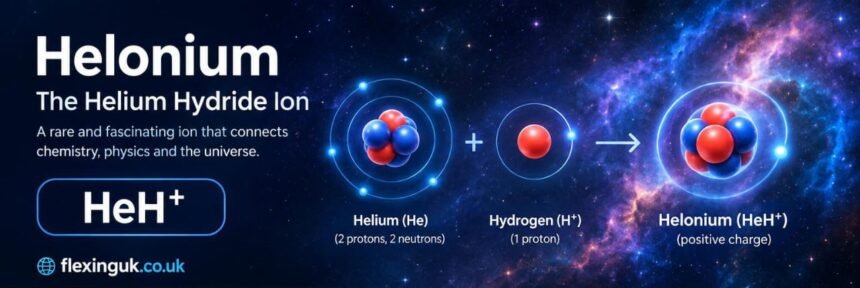
Helonium is an unusual scientific term that can easily be mistaken for the name of a chemical element. In inorganic chemistry, however, helonium refers to the helium hydride ion, HeH⁺—a positively charged molecular ion made from helium and hydrogen.
The word is especially interesting because helium is generally known as a chemically unreactive noble gas. Yet under appropriate conditions, helium can form a bond with hydrogen and produce HeH⁺. This tiny ion has attracted attention not only in laboratory chemistry but also in astrophysics because of its connection to the chemistry of the early universe.
If you searched for helonium meaning, what is helonium, or HeH⁺, this guide explains the term in simple language, including its formula, formation, pronunciation, history, scientific importance, and common misunderstandings.
What Is Helonium?
Helonium is another name for the helium hydride ion, written chemically as HeH⁺. It is a molecular cation, meaning that it is a molecule-like species carrying an overall positive electrical charge.
The formula is quite simple:
HeH⁺
- He = helium
- H = hydrogen
- ⁺ = one positive electrical charge
Unlike helium itself, which is a chemical element, helonium is not an element on the periodic table. It is a chemical species containing two different kinds of nuclei.
This distinction is important because the word helonium sounds as though it might describe a new element. It does not.
Is Helonium the Same as Helium?
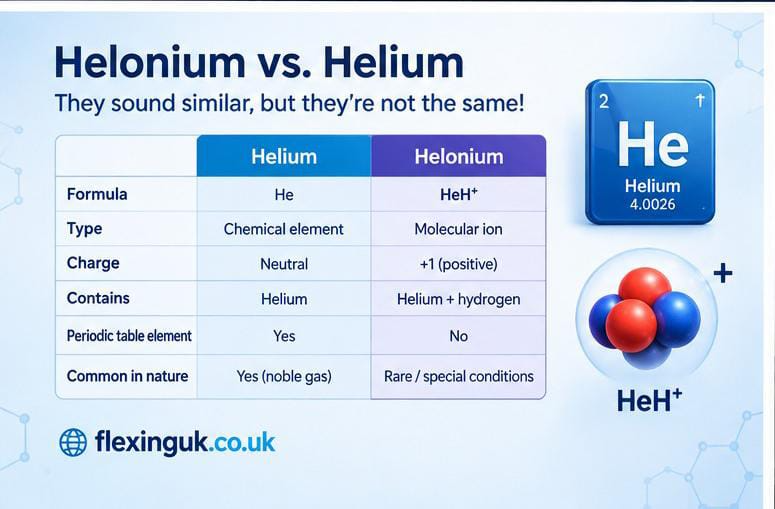
No. Helium and helonium are chemically different.
| Feature | Helium | Helonium |
|---|---|---|
| Formula | He | HeH⁺ |
| Type | Chemical element | Molecular ion |
| Charge | Neutral | +1 |
| Contains | Helium | Helium + hydrogen |
| Periodic-table element | Yes | No |
| Scientific field | Chemistry, physics | Chemistry, astrophysics |
Helium has atomic number 2, meaning every helium atom contains two protons. Helonium does not have its own atomic number because it is not a separate element.
Helonium Meaning Explained Simply
The easiest way to understand the word is:
Helonium = helium hydride ion = HeH⁺
The ion can be thought of as helium associated with a hydrogen nucleus, with the resulting species carrying a positive charge.
A simplified representation is:
He + H⁺ → HeH⁺
This equation is useful for understanding the basic idea, although actual formation pathways can be more complicated depending on the physical environment.
The positive charge is one of the features that makes HeH⁺ chemically unusual. It is not simply a mixture of helium gas and hydrogen gas.
Why Is Helonium So Unusual?
Helium is famous for being a noble gas. Its electrons occupy a particularly stable configuration, which makes ordinary helium relatively resistant to chemical bonding.
That is why the existence of HeH⁺ is so fascinating.
Helium Can Participate in Chemical Bonding
In helonium, helium and hydrogen are associated strongly enough to produce a distinct molecular ion. This demonstrates that the apparent chemical inactivity of helium does not mean that helium can never participate in molecular chemistry.
The environment matters enormously.
Under ordinary everyday conditions, you should not expect a container of helium and hydrogen to spontaneously become filled with stable helonium. HeH⁺ is highly reactive and is generally encountered under specialized conditions such as plasmas, laboratory experiments, or certain astronomical environments.
A Tiny Ion With a Big Scientific Story
HeH⁺ is one of the simplest heteronuclear molecular ions because it involves only two different atomic nuclei.
That simplicity makes it valuable for studying molecular structure, chemical bonding, spectroscopy, and the behavior of matter under unusual conditions.
What Does the “+” in HeH⁺ Mean?
The plus sign is essential to understanding helonium.
HeH⁺ has an overall positive charge of one. In simplified terms, it can be described as helium and hydrogen associated in a species in which an electron is absent compared with the corresponding neutral combination.
This makes helonium a cation.
What Is a Cation?
A cation is an ion with a positive electrical charge.
For example:
- Na⁺ is a sodium cation.
- H⁺ is a hydrogen ion in common simplified chemical notation.
- HeH⁺ is a positively charged helium-hydrogen molecular ion.
So, when you see HeH⁺, the plus sign is not decorative. It tells you that the species has a net positive charge.
How Is Helonium Formed?
The formation of HeH⁺ depends on the environment, energy conditions, and available particles.
A simplified reaction is:
He + H⁺ → HeH⁺
Here, a hydrogen ion interacts with helium to form the helium hydride ion.
In real laboratory and astrophysical environments, however, chemical networks can involve several competing reactions. The ion may also be destroyed when it encounters other particles.
This helps explain why helonium is not something normally stored in a bottle like ordinary helium.
Why Can’t Helonium Be Easily Stored?
HeH⁺ is extremely reactive. If it encounters suitable molecules or atoms, it can participate in reactions that destroy the ion.
Therefore, researchers generally study it under controlled conditions rather than treating it as a conventional bulk chemical substance.
The History of Helonium Research
The scientific history of helonium stretches back nearly a century.
HeH⁺ was first produced experimentally in 1925, giving scientists direct evidence that this unusual helium-hydrogen ion could exist.
For many years, scientists also considered whether the ion might exist naturally in space.
That question was particularly important for astrochemistry because HeH⁺ was expected to be involved in the chemistry of very early cosmic environments.
Helonium and the Early Universe
One of the most interesting reasons scientists study helonium is its connection with the early universe.
After the Big Bang, the universe gradually cooled enough for atoms and eventually molecules to form. Scientists have proposed that HeH⁺ was among the earliest molecular species to appear during this transition from an ionized environment toward more complex chemistry.
This does not mean that helonium is literally floating around everywhere in today’s universe. Instead, its importance comes from what it can tell scientists about the conditions under which early molecular chemistry began.
Why Does Early-Universe Chemistry Matter?
Understanding early molecules helps scientists investigate questions such as:
- How did the first chemical bonds develop?
- How did simple atoms become molecules?
- What processes eventually allowed more complex chemistry to emerge?
- How did early cosmic chemistry contribute to the formation of later structures?
Because HeH⁺ is so simple, it provides a useful theoretical and observational case for studying these fundamental processes.
Was Helonium Ever Detected in Space?
Yes. After decades of theoretical interest, astronomers reported an unambiguous detection of HeH⁺ in space in 2019.
The detection involved observations of the planetary nebula NGC 7027, using NASA’s airborne SOFIA observatory.
This was significant because scientists had expected helium hydride ions to exist in certain astrophysical environments, but directly identifying the ion had remained difficult.
Why Was the Detection Difficult?
Space contains many different atoms, ions, and molecules that produce spectral signals.
Scientists therefore need to distinguish the characteristic spectral signature of one molecule or ion from the signals produced by everything else in the observed environment.
The 2019 observation provided important observational evidence supporting the presence of HeH⁺ in an astronomical setting.
Helonium vs. Helionium: Are They Different?
Yes. Helonium and helionium should not automatically be treated as the same word.
This is an important spelling distinction because the two terms differ by only one letter.
Helonium
Helonium refers to the helium hydride ion:
HeH⁺
It belongs to the fields of inorganic chemistry, molecular physics, and astrophysics.
Helionium
Helionium is a separate and much less familiar term associated with a different physical concept.
Therefore, if you are writing about HeH⁺, the correct keyword is helonium, not helionium.
Where Does the Word “Helonium” Come From?
The word is formed from helium + -onium. The suffix -onium appears in chemical terminology associated with positively charged species.
The construction can make the word sound like the name of an element, but its grammatical and scientific function is different.
Compare:
- Helium → an element
- Helonium → a chemical ion
- Hydrogen → an element
- Hydronium → a positively charged molecular ion
The naming pattern is therefore useful, but the name itself should not be interpreted as evidence that helonium is a separate element.
How Do You Pronounce Helonium?
A practical English pronunciation is approximately:
hee-LOH-nee-um
Because helonium is a specialized scientific term rather than an everyday English word, pronunciation can vary somewhat between speakers.
If you are using it in a presentation, the safest approach is to pronounce the word clearly and immediately connect it with HeH⁺, the helium hydride ion.
Common Mistakes About Helonium
Because the term is unfamiliar, several misunderstandings are easy to make.
Mistake 1: Calling Helonium an Element
Incorrect:
“Helonium is a newly discovered element.”
Correct:
“Helonium is another name for the helium hydride ion, HeH⁺.”
Helonium does not have its own position or atomic number on the periodic table.
Mistake 2: Saying Helonium Is Ordinary Helium
Incorrect:
“Helonium is another form of helium gas.”
Correct:
“Helonium is a positively charged molecular ion containing helium and hydrogen.”
The difference is fundamental: helium is an element, whereas HeH⁺ is a molecular ion.
Mistake 3: Confusing Helonium With Helionium
Incorrect:
“Helonium and helionium are simply alternate spellings.”
Correct:
“The terms helonium and helionium can refer to different scientific concepts.”
When accuracy matters, always check the spelling and context.

Mistake 4: Assuming It Is Common in Everyday Chemistry
Incorrect:
“Helonium is commonly found in household chemicals.”
Correct:
“Helonium is primarily a specialized species studied in controlled laboratory and astrophysical environments.”
Why Is Helonium Important to Scientists?
Helonium matters because it connects several areas of science that might otherwise seem unrelated.
1. Molecular Chemistry
HeH⁺ provides a remarkably simple example of a molecular ion and chemical bonding involving helium.
2. Spectroscopy
Its spectral characteristics can help researchers identify the ion in astronomical environments.
3. Astrophysics
The detection of HeH⁺ in space provides insight into chemical processes occurring in planetary nebulae and other environments.
4. Early-Universe Research
Its predicted role in early cosmic chemistry makes it relevant to models of how the first molecules formed.
5. Fundamental Physics
Because the system is so simple, theoretical calculations of its structure and behavior can be compared with experimental and astronomical observations.
What Can Helonium Teach Us About Chemistry?
Helonium is a good reminder that chemistry is not always as simple as memorizing the periodic table.
Helium is normally presented as an extremely unreactive noble gas. Yet under particular physical conditions, it can participate in an ion containing hydrogen.
That teaches an important broader lesson: chemical behavior depends on conditions.
Temperature, pressure, radiation, charge, energy levels, and the surrounding particles can all influence what chemical species can exist.
HeH⁺ is therefore interesting not because it is a common substance, but because it demonstrates how unusual molecular behavior can emerge under the right circumstances.
A Quick Reference Guide to Helonium
| Question | Answer |
|---|---|
| What is helonium? | The helium hydride ion |
| Chemical formula | HeH⁺ |
| Is it an element? | No |
| Is it an ion? | Yes |
| Charge | +1 |
| Main atoms | Helium and hydrogen |
| Common scientific name | Helium hydride ion |
| First laboratory production | 1925 |
| Astronomical detection | 2019 |
| Related field | Astrochemistry and molecular physics |
| Everyday substance? | No |
Frequently Asked Questions About Helonium
1. What does helonium mean?
Helonium means the helium hydride ion, HeH⁺. It is a positively charged molecular ion containing helium and hydrogen.
2. Is helonium a real chemical?
Yes. Helonium is a real chemical species that has been produced experimentally and identified in an astronomical environment. It is more precisely described as a molecular ion rather than an ordinary bulk chemical.
3. What is the formula for helonium?
The chemical formula is HeH⁺. The formula indicates helium and hydrogen with an overall positive charge.
4. Is helonium an element?
No. Helonium is not a chemical element. Helium is the element; HeH⁺ is a molecular ion made from helium and hydrogen.
5. Why is helonium scientifically important?
HeH⁺ is important because it provides insight into unusual chemical bonding, molecular physics, spectroscopy, astrophysical environments, and the development of early molecular chemistry.
6. When was helonium first made?
The helium hydride ion was first produced experimentally in 1925.
7. Was helonium found in space?
Yes. Astronomers reported a definitive astronomical detection of HeH⁺ in 2019, observing its spectral signature in the planetary nebula NGC 7027.
8. Is helonium the same as helionium?
No. The two terms have different spellings and can refer to different concepts. Helonium is the term associated with the helium hydride ion HeH⁺.
Conclusion
Helonium is the helium hydride ion, HeH⁺—a positively charged molecular species formed from helium and hydrogen. Despite its element-like name, it is not a new element or another form of ordinary helium.
Its unusual chemistry makes it scientifically valuable, while its detection in space has strengthened its importance in astrophysics and astrochemistry. From laboratory experiments beginning in 1925 to astronomical observations reported in 2019, helonium demonstrates how a tiny and highly reactive ion can provide clues about some of the biggest questions in chemistry and the history of the universe.